
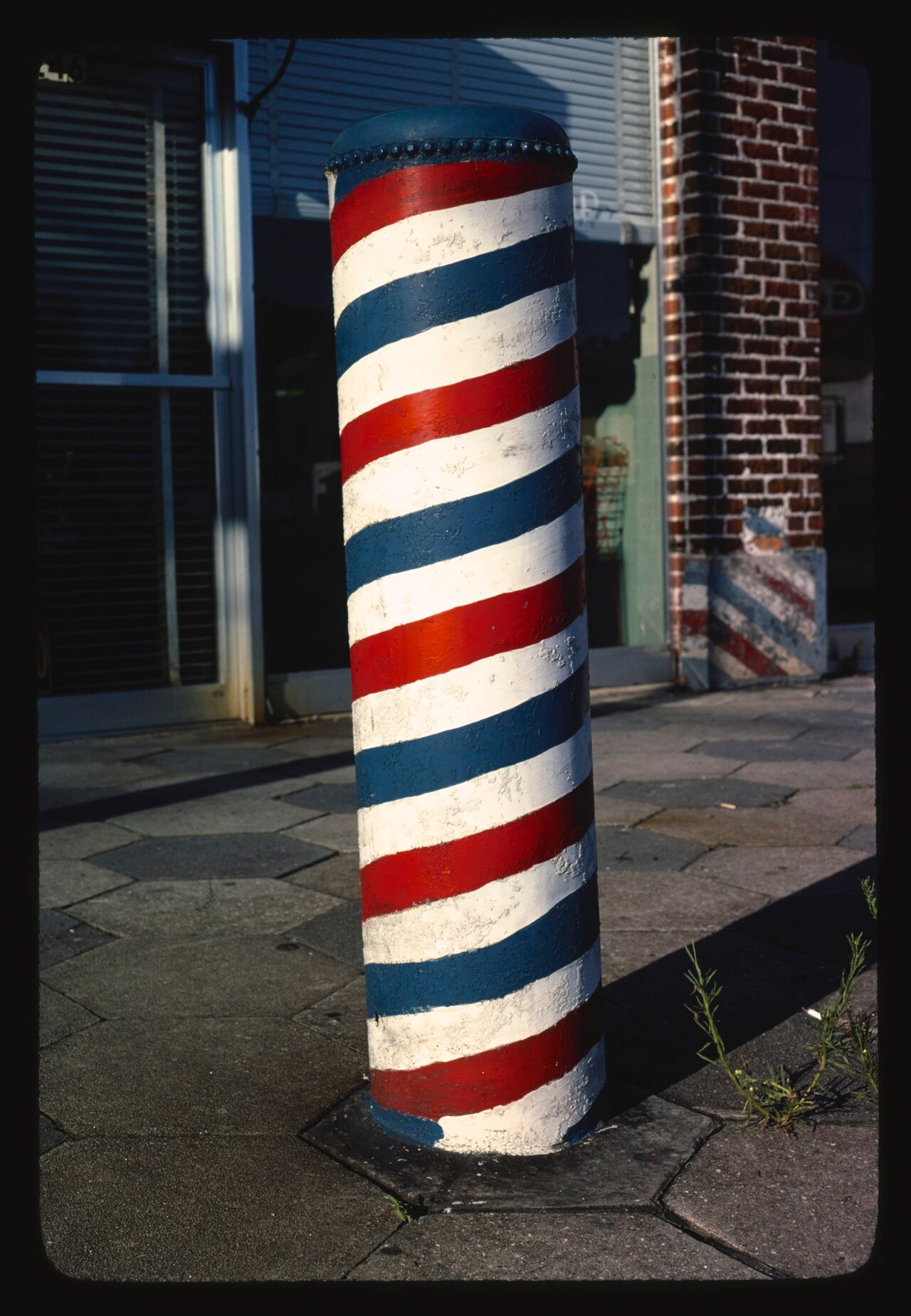
The Most Famous Sign in the Trade
Every barber knows the pole. Red, white and blue stripes turning in the window, visible from halfway down the block, understood in every country on earth without a single word: barber here.
What most people don’t know — including plenty of barbers — is that the pole has nothing to do with hair. It’s a leftover from the centuries when your barber was also your surgeon, and the stripes tell the story of the bloodiest side job in history.
When Barbers Did the Blood Work
In medieval Europe, medicine and grooming were the same trade. Barbers cut hair and shaved beards, but they also pulled teeth, lanced boils, set bones, leeched patients and performed bloodletting — for centuries the most common medical treatment for almost everything.
There was a practical reason barbers ended up with the job. In 1163, the Church barred clergy from shedding blood, and monks and priests had been doing much of the era’s medical work. Surgery was considered rough, manual work — and the men with the sharpest blades, the steadiest hands and a shop on the street were the barbers. The barber-surgeon was born.
Where the Stripes Come From
Bloodletting needed equipment, and the equipment became the advertisement. A patient would grip a strong pole or staff tightly to make the veins in the arm stand out. The barber kept bandages ready — some to bind the arm, some to dress it afterward.
When the work was done, the pole and the bandages went outside the shop. The staff stood by the door as a sign of the trade, and the washed bandages were hung on it to dry in the sun and wind — where they twisted around the pole in a spiral. Everyone passing by knew exactly what that meant: blood and bandages, letting done here.
The painted pole kept the picture after the real bandages were gone. Red for blood. White for the bandages. The blue in American poles came later — often said to stand for the veins, or simply for the colors of the flag. European poles traditionally stayed red and white.
One Guild, Then a Divorce
For a long time, the partnership was official. In 1540, Henry VIII formally united London’s barbers and surgeons into a single company — though even then, the cracks were showing: barbers were restricted from surgery (except pulling teeth), and surgeons were told to stay out of the shaving business.
It didn’t hold. As medicine grew more scientific, the surgeons wanted distance from the men who cut hair. In 1745, under George II, the surgeons split off to form their own company — the ancestor of the Royal College of Surgeons. France made a similar break around the same era. The barbers kept the shops, the chairs and the pole. The surgeons kept the scalpels — and eventually became doctors.
The Pole Survives
Through the 1800s, barbering shed the last of its medical duties and became the trade we know: cuts, shaves, and the shop as the neighborhood’s living room. The pole came along for the ride. Chair and fixture makers like Koken and Theo A. Kochs built poles into their catalogs, and in the 1950s the William Marvy Company of St. Paul, Minnesota made the motorized, revolving pole a standard piece of American storefront hardware.
The pole was so tied to the trade that some jurisdictions once regulated who could display one — it was a licensed barber’s sign, not a decoration.
Why It Still Matters
Today the pole is pure barbering. No blood, no bandages, no surgery — just the oldest logo in the business, still turning in windows from New York to Tokyo. Every barber who hangs one is flying a flag with about 800 years of history in it.
And there’s something fitting in where it came from. The pole started as a working tool, hung outside by a working tradesman to say: skilled hands inside. That’s still exactly what it says.
Looking for a shop with skilled hands — or a chair of your own in one? Browse open barber jobs and booth rentals or post your opening free.
Photo: Barber pole, Jacksonville, Florida, 1979 — John Margolies, Library of Congress.